City of Wanneroo Japanese Translation Services
Perth Translation Services » City of Wanneroo Japanese Translation Service
City of Wanneroo Japanese Translation Services
 Japanese to English translation requires navigating three writing systems and a document culture built around the unique koseki family register system, which has no equivalent in Western countries. NAATI-certified Japanese translators in Australia are well established, particularly in cities with significant Japanese business and expatriate communities. Clients commonly need translations of family registers for marriage or visa applications, academic transcripts for skills recognition, and corporate documents for business migration. The structural differences between Japanese and English — including reversed sentence order, implicit subjects, and context-dependent meaning — make this one of the more technically demanding NAATI language pairs.
Upload Document For Translation

City of Wanneroo Japanese Translator Services
Japanese translator for certified translation services:
- Japanese driving license translation
- Japanese financial translation and bank statement translations
- Japanese birth certificate translation
- Japanese marriage certificate translation
- Japanese name-change certificate translation
- Japanese degree translation
- Japanese diploma translation
- Japanese school transcript translation
- Japanese passport translation
- Japanese police report translation
- Japanese police check translation
- Japanese personal letters and cards
- Japanese utility bill translations
- Japanese death certificate translation
Perth Translation provides fast and affordable Japanese translation services in the City of Wanneroo for all types of personal documents by NAATI translators.

City of Wanneroo
The City of Wanneroo is a local government area with city status in the northern suburbs of Perth, Western Australia. It is centred approximately 25 kilometres (15.5 mi) north of Perth's central business district and forms part of the northern boundary of the Perth metropolitan area.
City of Wanneroo History
Prior to 1902, Wanneroo was part of the Perth Road District, which eventually went on to become the City of Stirling. Wanneroo was established on 31 October 1902 as a road board under the Roads Act 1888. The board was named after the Wanneroo wetlands in the area, first explored and recorded by John Butler in 1834.
With the passage of the Local Government Act 1960, all road boards became shires effective from 1 July 1961, and the Shire of Wanneroo came into being, encompassing everything north of Beach Road and west of Alexander Drive. With the development of and subsequent population growth surrounding Joondalup, the Shire of Wanneroo attained City status on 31 October 1985.
City of Wanneroo Suburbs
The City of Wanneroo includes the suburbs and localities of Alexander Heights, Alkimos, Ashby, Banksia Grove, Butler, Carabooda, Carramar, Clarkson, Darch, Eglinton, Girrawheen, Gnangara, Hocking, Jandabup, Jindalee, Koondoola, Landsdale, Madeley, Marangaroo, Mariginiup, Merriwa, Mindarie, Neerabup, Nowergup, Pearsall, Pinjar, Quinns Rocks, Ridgewood, Sinagra, Tamala Park, Tapping, Two Rocks, Wangara, Wanneroo, Woodvale (part) and Yanchep.Our NAATI accredited Japanese translators in Perth provide official Japanese to English and English to Japanese translations for all document types, accepted by the Department of Home Affairs and Australian authorities.
パースのNAATI認定日本語翻訳者が、すべての文書タイプについて日本語から英語、英語から日本語への公式翻訳を提供しています。内務省およびオーストラリア当局に認められています。
About Japanese Translation
Japanese uses three writing systems simultaneously — hiragana, katakana, and kanji — and a single document may contain all three plus Arabic numerals and Latin characters. The language has elaborate honorific systems (keigo) with distinct polite, humble, and respectful forms that affect verb conjugation and vocabulary choice in official documents. Sentence structure is subject-object-verb, articles do not exist, and context frequently determines meaning that would be explicit in English.
Japanese writing combines kanji (Chinese-derived logographic characters, with over 2,000 in common use), hiragana (46 syllabic characters for native words and grammar), and katakana (46 syllabic characters for foreign loanwords). Text can run vertically (top to bottom, right to left) or horizontally (left to right), and official documents may use either orientation.
Common Japanese Documents
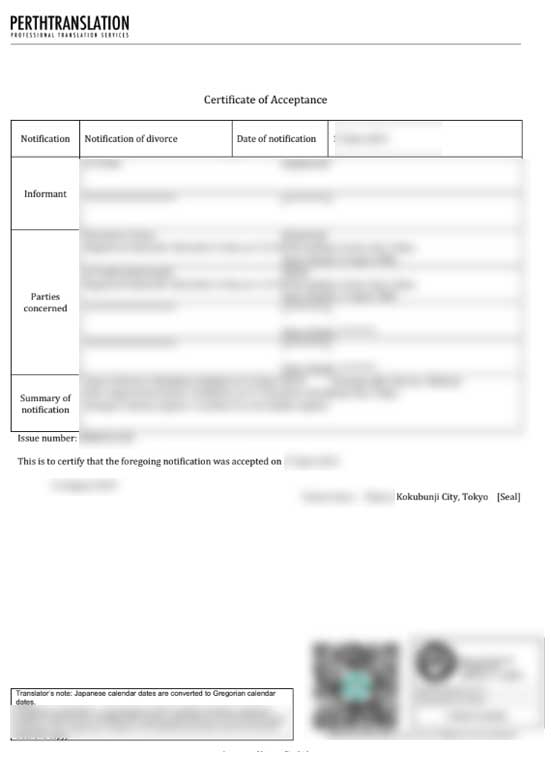
Japanese documents frequently requiring translation include the koseki tohon (family register), juminhyo (residence certificate), sotsugyō shōmeisho (graduation certificate), and unten menkyo shō (driver's licence).
Japanese Document Requirements
Japanese civil documents such as the koseki tohon (family register) and juminhyo (resident certificate) are issued by municipal ward offices and form the backbone of Japan's identity documentation system. The koseki system is unique to Japan and records family lineage rather than individual events, which can complicate extraction of equivalent information for Australian authorities. Japan is a Hague Convention member, and apostille is available from the Ministry of Foreign Affairs.
NAATI offers certification for Japanese, and there is a solid pool of NAATI-certified Japanese translators in Australia, particularly in Sydney, Melbourne, and Brisbane. Japanese translation for immigration purposes requires NAATI certification, and the complexity of the koseki system means translators need specific familiarity with this document type.
About the Japanese Language
Japanese has no grammatical plural — the word for "cat" and "cats" is the same (neko), and context determines quantity. The language has three completely separate writing systems used simultaneously in a single sentence: kanji (Chinese characters) for content words, hiragana for grammar, and katakana for foreign loanwords. Japanese is considered one of the most difficult languages for English speakers to learn, with the US Foreign Service Institute estimating 2,200 class hours to reach proficiency — roughly four times longer than Spanish or French.
Japanese Speakers in the City of Wanneroo Area
The Japanese-born community in Australia numbers around 50,000, with concentrations in Sydney, Melbourne, Brisbane, and the Gold Coast. Migration has been driven by business, education, and lifestyle factors, with a notable presence in tourism and hospitality sectors.
About City of Wanneroo
The City of Wanneroo is one of the fastest-growing local government areas in Australia, located in Perth's northern corridor. It spans from established coastal suburbs like Quinns Rocks and Mindarie to rapidly expanding inland suburbs including Landsdale, Madeley, Tapping, Banksia Grove, and Yanchep. The city covers a vast area extending north to Two Rocks and includes significant bushland and rural zones.
Wanneroo has a growing multicultural population reflecting its status as a major growth area attracting families from across the world. Significant communities include those from the United Kingdom, India, South Africa, the Philippines, and New Zealand. Girrawheen and Alexander Heights have established Vietnamese, Chinese, and African communities, and newer suburbs are increasingly diverse as young migrant families settle in affordable new housing estates.
The City of Wanneroo conducts regular citizenship ceremonies and provides community grants to multicultural organisations. The council runs community development programs across its vast area and partners with settlement service providers to support newly arrived residents, particularly in the established southern suburbs.
Key facilities include the Wanneroo Library, Girrawheen Library, Clarkson Library, and the Two Rocks Library. The Wanneroo Civic Centre houses council offices, and the Wanneroo Showgrounds host community events. Health services are available at Joondalup Health Campus nearby, and Centrelink services are accessible at Joondalup or Mirrabooka.
NAATI certified translation delivery that you can trust, all services based in Australia. To get started, please email your documents to: enquiry@perthtranslation.com.